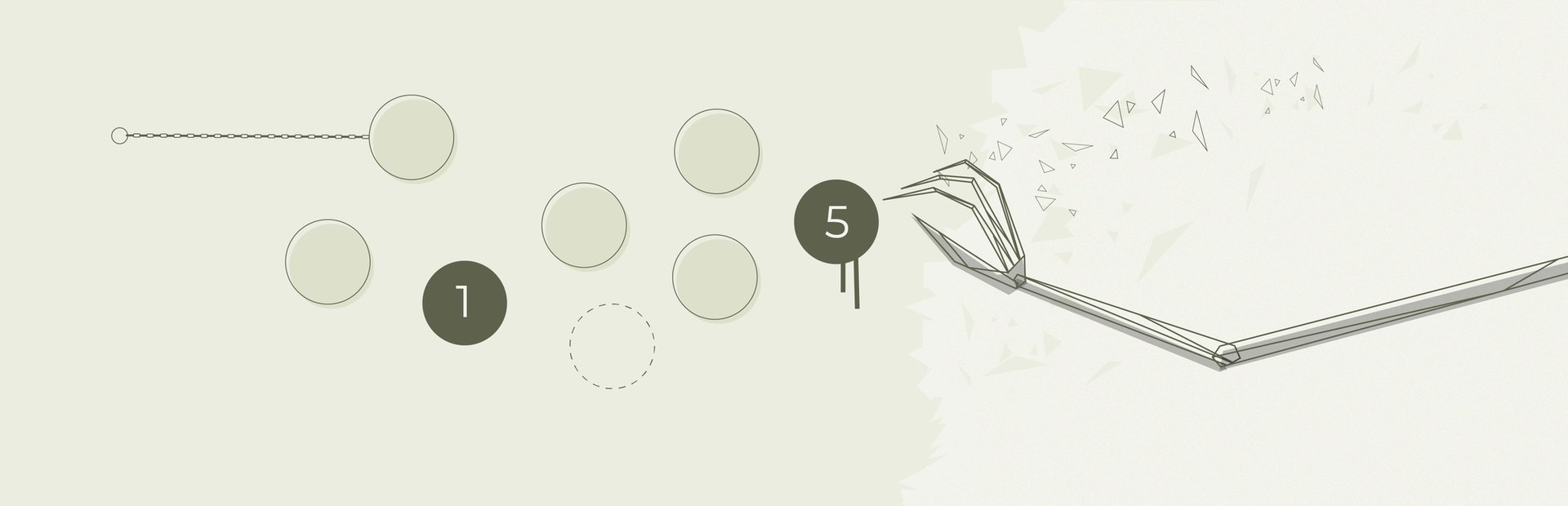
Stip will release on January 20, 2027, developer SixtyFour announced during the Point & Click Showcase on November 4. The PC puzzle game begins with the apparent simplicity of putting numbers into dots, then asks players to work out rules that the game does not explain in advance.
Developer Sam Agten’s release announcement places that rule discovery inside a larger maze of rooms and hidden connections. A free Steam demo is available ahead of launch, allowing players to sample the approach without waiting for January.
The rule is part of the puzzle
The Steam description establishes a distinction between entering a correct answer and understanding why it is correct. Numbers must satisfy constraints, but those constraints are deliberately left for the player to infer. Progress therefore involves observation and testing as well as the final arrangement.
That creates two related questions: what does a particular puzzle require, and what has it taught the player that might be useful elsewhere? The advertised structure connects puzzles across rooms and introduces new mechanics as the maze opens up. It is not simply a menu of unrelated number grids.
This is an important distinction for anyone deciding whether the premise suits them. A conventional tutorial can demonstrate a rule and then ask the player to apply it. Stip makes identifying the rule itself part of the work, so uncertainty is built into the advertised design rather than treated as an obstacle to be removed by an explanation screen.
The surrounding maze contains its own clues
SixtyFour says the rooms contain environmental details, items and hidden rules that lead into a wider mystery. The promotional presentation also plays with the game’s relationship to its audience, including attention, encouragement and apparently reassuring messages.
The announcement says clues extend into material outside the executable, including trailers, social posts, store copy and press releases. That does not mean players should assume every piece of punctuation is essential to completion. It does establish that the project deliberately uses its surrounding publicity as part of the puzzle fiction.
Agten estimates the full game will take roughly five to six hours. That is a developer estimate rather than a guarantee: a game centered on discovering hidden relationships is particularly dependent on how quickly a player recognizes them. The announcement does not assign that running time to the demo.
A separate demo is available now
The Steam demo page lists a free, single-player Windows download, with English and Dutch support and Steam Cloud. It is a separate application from the forthcoming full release, so trying it does not require buying the January game.
The demo’s May 29 listing date also means this week’s announcement is about the full release schedule, rather than the first public opportunity to play. For players attracted by the mixture of number constraints and environmental discovery, the useful test is already available: whether learning an unfamiliar rule feels like the reward, rather than a step that should have been explained before the puzzle began.
Have a correction or a useful perspective?
Get in touch with the publication.