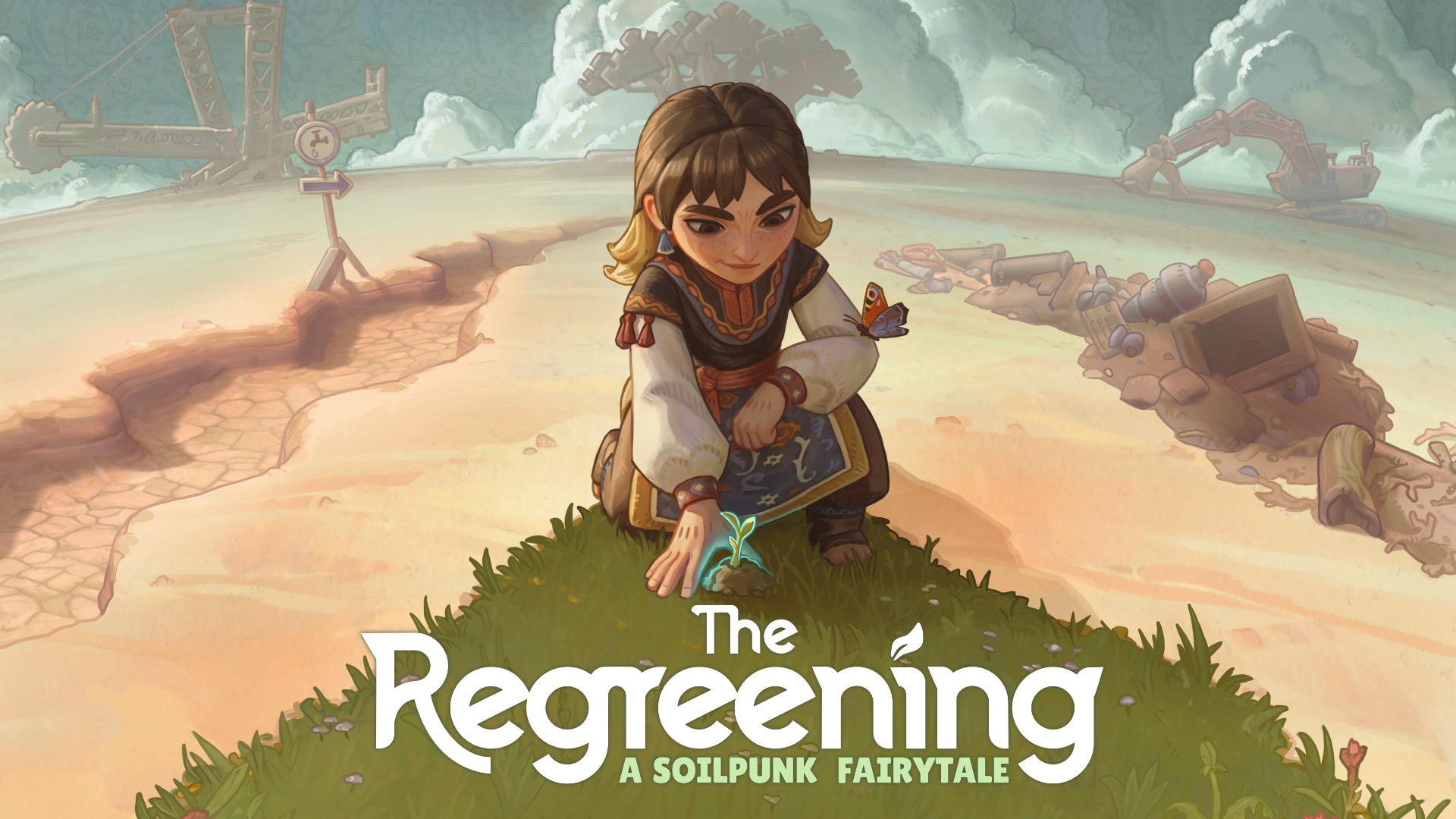
The Regreening will launch on December 7, 2026, giving Positive Impact Games’ habitat-restoration simulation a firm release date. Its Steam demo is already available, with recent updates expanding the places players can restore and adjusting the practical work of watering, gathering and claiming restoration rewards.
The release announcement introduces Viri and her grandmother in a damaged world where bringing life back to the landscape is the central task. It is a single-player game built around restoration, rather than a competitive farming economy.
Plants support a returning ecosystem
According to the official description, players choose habitats, plant seeds and use relationships between plants to help an area recover. Flowers and berries can be harvested for further planting or gifts, while rubbish becomes useful material for furniture and equipment.
Watering systems are part of that work, making discarded objects useful beyond clearing visual clutter. The game also includes nature spirits inspired by folklore, whose requests can provide access to new abilities. Its advertised structure avoids timers and pressure to complete tasks at a particular pace.
The connection between planting and wildlife is especially clear in the demo’s crow habitats. They provide a concrete target for restoration: creating somewhere suitable for an animal, rather than maximizing the sale price of a crop. The soundscape is designed to change as life returns, adding an audible response to progress alongside the altered scenery.
The demo shows more than an introductory plot
The October demo announcement introduced the Junkyard area, a preview of the Gorge and spirits named Ophis and Lis. It also added a quest journal and the option to switch grandmother’s tips on or off, providing different levels of guidance without changing the restoration premise.
Other additions include upcycled furniture, straw mulch and upgrades for a hand-pump well. Together, those features show how the game combines planting decisions with the construction of a more manageable working environment. Restoring a place involves improving the tools and facilities available there, not simply placing more plants.
The Steam Next Fest patch then addressed several interactions that could interrupt that loop. It corrected irrigation-bottle removal and filling, made hand-pump wells persist correctly, and reduced watering requirements for mature plants. Pebble-compost drops were increased, while the costs of half-moon berms and irrigation bottles were lowered.
Progress is tracked separately for each location
The same patch clarified restoration rewards and weather progression. Rewards must meet the required restoration percentage, are claimed only once and are tracked for the relevant map. Unlocking rain in Earthbound Plains should not automatically unlock it in the Junkyard.
That distinction gives each area its own restoration process. A player cannot assume that fixing the first location settles the conditions everywhere else; equipment, habitat development and local progress continue to matter as Viri moves through the world. The existing demo offers a way to see those systems before the December release.
Have a correction or a useful perspective?
Get in touch with the publication.