Factorio 2.1 moved to the stable branch on October 23, bringing the experimental version’s logistics and control improvements to players who stayed on 2.0. For Space Age factories, the most consequential changes concern how cargo reaches orbit, how platforms exchange supplies and how circuits turn demand into action.
Wube’s stable-release summary describes a refinement of the existing game, rather than another set of planets or research trees. The distinction matters for an established factory: the update changes how familiar infrastructure can be assembled and controlled.
Mixed rockets address small construction requests
Previously, assembling a platform could mean sending a rocket-load of each requested item type, even when the blueprint needed only small quantities. Version 2.1 can combine different items into one launch. The logistics development notes explain that the automatic system prioritizes lower request counts, helping one-off construction supplies compete with bulk material shipments.
The packing logic does not promise a mathematically perfect load. It can send extra quantities of heavily requested items to fill available space and fall back to a single-item launch when a mixed batch cannot be formed. Those details explain why a working rocket may carry more than the minimum requested quantity without necessarily indicating a broken circuit.
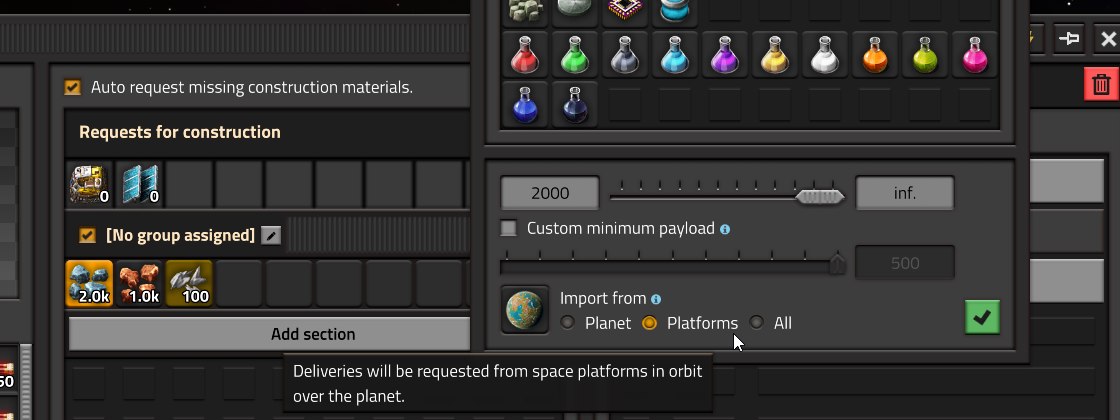
Platforms can also request supplies from other platforms in orbit. Leaving the import-source selection empty allows suitable items to come from any location. For a ship that needs common fuel, ammunition or repair materials, a flexible request can avoid tying the supply chain to one designated source.
The practical change is a wider choice of network designs. A construction platform and a transport platform no longer have to be treated as completely separate destinations that can only receive their own ground launches. The exact benefit still depends on the factory’s production, storage and schedules.
Circuits separate commands from measurements
The circuit and landing-pad overview explains the new separation of inputs and outputs by wire color. A machine can receive a command on one network and report its contents on another, replacing the earlier automatic subtraction behavior. Wube identifies existing assembler and asteroid-collector setups as designs that may need adjustment.
Labs can choose research using an ordered list of circuit conditions. The first satisfied condition selects the technology, completed research is skipped, and repeating technologies can be queued again. When a lab controls research, the normal manual queue is blocked with a message pointing back to that lab. An apparently unavailable research queue may therefore be an intended consequence of automation.
Landing-pad unloading bays let inserters take arriving cargo directly into trains, belts or chests. Boiler and heat-exchanger circuit connections provide another control point for backup power. These additions reduce the need to route every transfer through the same logistics solution.
Check an existing factory before replacing its save
Version 2.0 worlds can be loaded in 2.1, but saves and blueprints updated to the newer version cannot be downgraded. Wube recommends retaining copies and checking required mods. A successful load also does not prove that every circuit still produces the old result; the changed input/output rules make a functional inspection worthwhile.
The stable release also allows Space Age without the Quality component, with the Recycler separated into its own mod, and adds native ARM64 Linux support. These are distinct options within the release. Players can adopt the transport improvements without assuming every other part of their preferred factory configuration must be redesigned at the same time.
Have a correction or a useful perspective?
Get in touch with the publication.